
Know Your Traffic ROI in Days, Not Months
July 21, 2026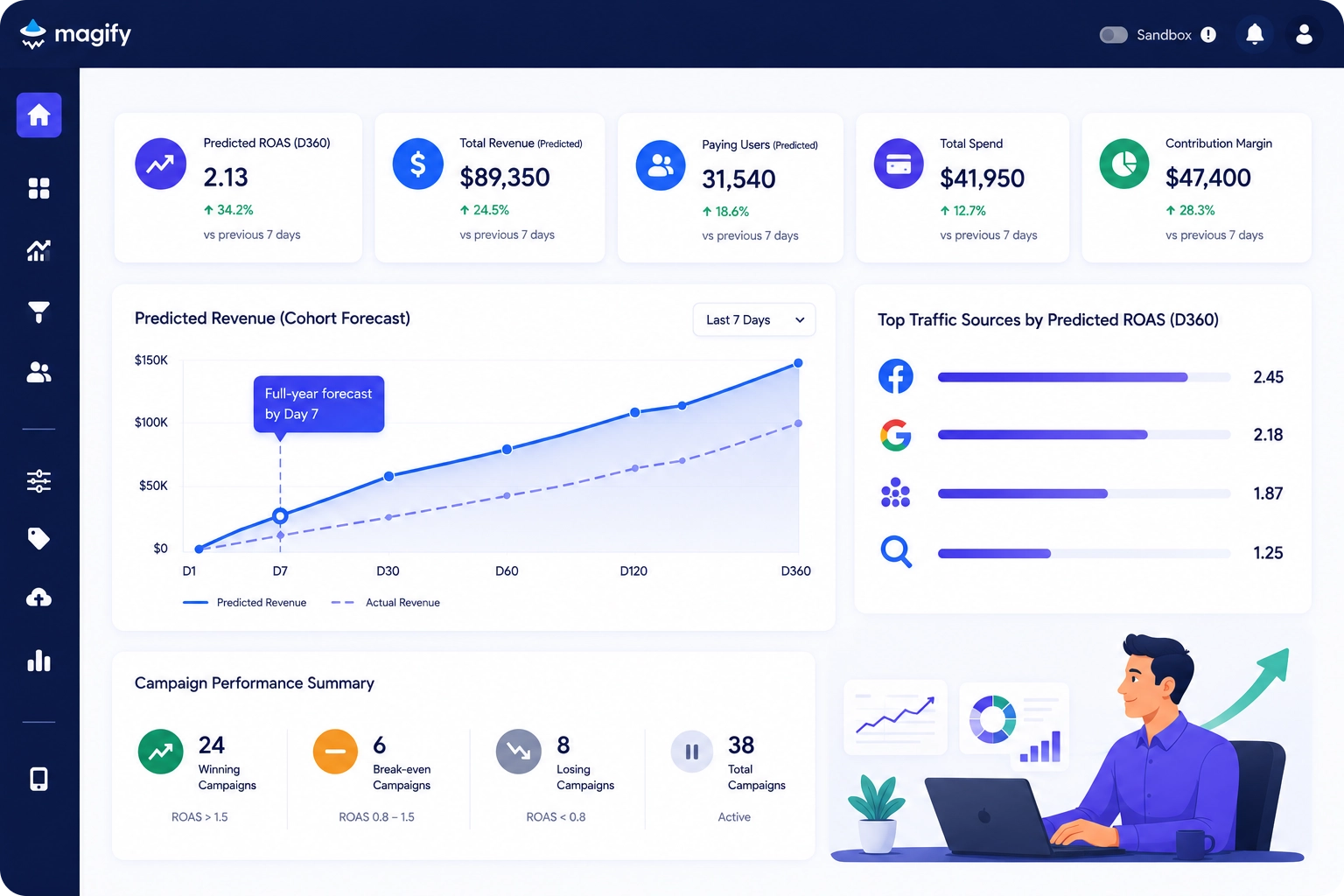
Traditional traffic analytics makes you wait. Cohorts take weeks or months to "mature," and while your team waits for actual ROAS, budget keeps flowing into unprofitable sources — while winning campaigns stay under-scaled. Every day of waiting is either lost profit or direct losses. With traffic costs rising and ad auctions overheated, decision speed is your competitive edge.
To be fair, predictive analytics isn't new. Plenty of companies build forecasts using coefficient models: take a historical ratio (say, D7 to D360), multiply your current numbers by a static coefficient, and you get a prediction. It works - as long as the market stands still. It doesn't.
There's also a hard entry requirement: coefficient models need at least a year of historical data. New projects simply don't have that history. So the model has to guess that your project will behave like some previous one. In other words, the forecast for your product is built on someone else's data — a different audience, different monetization, different market. Coefficient models have deeper problems too: They look backward. Coefficients come from past data and assume future cohorts will behave like old ones. Any change — a product update, new creative strategy, seasonality, an ad platform algorithm shift — makes the old coefficient obsolete. The model keeps making the same error until someone manually recalculates it.
They average everything. Coefficient models can't tell cohorts apart. Traffic from a new GEO or source may behave completely differently, but the model applies the same multiplier anyway. They can't see black swans — or white ones. A sudden drop in traffic quality, a viral spike, a shift in payment behavior — a static coefficient simply can't react to events that aren't in the historical data. In a fast-moving market, that's not a rounding error. It's a strategic risk.
We took a different path: predictive analytics powered by ML
Our reports forecast cohort payback up to Day 30 — starting from Day 1 of your campaign. The model reads early behavioral signals — engagement depth, activity patterns, early conversion events — and delivers an accurate short-term prediction. By Day 7, with enough cohort data collected, it builds a reliable forecast all the way to Day 360. One week after launch, you see your campaign's full-year outlook.
Unlike coefficient models, our ML model doesn't work with averaged multipliers — it works with the actual behavior of each cohort. Better yet, predictions are built per user, not per day. The model forecasts the value of every individual user based on their own behavior, instead of smearing an averaged curve across cohort days. The cohort forecast is the sum of individual predictions — fundamentally more accurate, because it reflects your real audience mix: payers, whales, and quick churners. The model catches anomalies and behavioral shifts early and adjusts the forecast, instead of dragging the error to the end of the period. It learns from every new cohort, adapting to your product, your traffic sources, and changing market conditions — no manual recalculation needed.
And one more thing: the model doesn't need a year of history. Predictions are available from Day 1, even for a brand-new project — built on the live behavior of your users, not the assumption that your product resembles someone else's.
What does this mean in practice?
A UA specialist evaluates a campaign within the first 24 hours and kills losing ones before they burn through the budget. Scaling stops being a guessing game: decisions are based on a D360 forecast, not gut feeling or CPA alone. Traffic sources are compared by predicted LTV — the metric that shows the real value of acquired users, not just the cost of acquiring them.
For executives, this means a predictable traffic P&L and the ability to plan budgets a year ahead — based on data, not hope. The whole acquisition team works with one clear efficiency metric, making control easier and communication faster between buyers, analysts, and management.
Stop waiting for cohorts to mature. Request a demo — we'll show you a forecast on your real data, and you'll see for yourself how much faster traffic decisions can be.
What to read next

How early LTV forecasts change mobile app economics
D0 Segmentation: How to Boost Revenue from Day One